The month of March is Women’s History Month, and to highlight the month, Amazon Conservation Association and its Peruvian sister organization, Conservación Amazónica – ACCA, have shared stories of women and girls around the world who are contributing to the protection, innovation, and education efforts to keep the Amazon Rainforest standing.
This past February 11th, Conservación Amazónica – ACCA hosted a webinar for International Day of Women and Girls in Science, highlighting women scientists leading significant research on Amazonian biodiversity. The webinar was entitled ‘Mujeres de Ciencia: Conservando los Andes Amazónicos e inspirando el futuro’ (Women in Science: Conserving the Andes Amazon and Inspiring the Future). A few of the featured researchers included:
Ruthmery Pillco, Protecting an Iconic Species in the Face of Climate Change
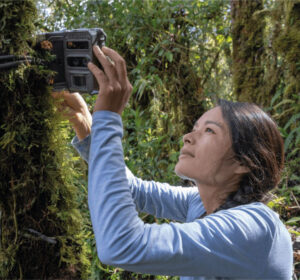
Pillco installing a camera trap in the field at Wayqecha Biological Station.
Ruthmery Pillco is a Quechuan scientist who has been recognized as a National Geographic Explorer and Disney Conservation Hero. Pillco leads the Andean Bear Conservation Project at Amazon Conservation’s Wayqecha Biological Station. Her work studies how Andean bear populations move throughout the Amazon. This surveying is important as the species disperses seeds throughout the forest, which is key in plant regeneration.
The work of Pillco on the Andean Bear Conservation Project has helped to reforest over 430,000 native trees, which has been crucial for wildlife and communities impacted by climate change.
“The Andean bear is an indicator of the state of health of the forests. Understanding their behavior helps us develop better conservation strategies.”
Ruthmery Pillco
Juliana Morales, Advancing the Understanding of Zoonotic Diseases in Peru
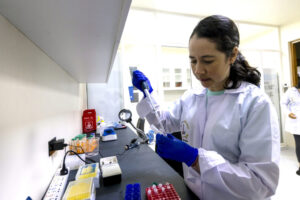
Morales conducting field research at Thomas Lovejoy Molecular Biology, Biodiversity, and Climate Change Laboratory at Amazon Conservation’s Manu Biological Station.
Juliana Morales is the Director of the Thomas Lovejoy Molecular Biology, Biodiversity, and Climate Change Laboratory at Amazon Conservation’s Manu Biological Station. Her work addresses the impacts of zoonotic diseases, such as Leishmaniasis, which are prevalent in tropical regions. Identification of disease transmission vectors and risks helps protect human health and improve conservation action.
“Our work allows us to better understand disease vectors and develop more effective prevention strategies for local communities.”
Juliana Morales
Erin Rivera, Conducting Insect Sampling for Ecosystem Health
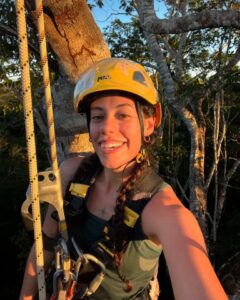
Rivera scales a tree at Amazon Conservation’s Los Amigos Biological Station to install UV light traps.
Erin Rivera is a visiting researcher at Amazon Conservation’s Los Amigos Biological Station who studies how insect diversity can be used as an indicator of ecosystem health. She uses UV light traps, digital analysis software, and other innovative technologies to understand how climate change and human alterations to the environment impact foundation species like insects.
“Insects can tell us a lot about environmental changes. They are key to understanding the health of the forest and its resilience to climate change.”
Erin Rivera
Muriel and Madeline, Bringing Awareness and Action for the Amazon


It’s not just women forging careers in science who are having incredible impacts on conservation of the Amazon. Two 5th grade sisters in San Diego, CA, held a bake sale to spread awareness about the impact of palm oil on the Amazon while raising money for Amazon Conservation to prevent deforestation in the region. They chose cookies as a fun way to get people involved and were successful in raising over $500 for Amazon Conservation!
They also shared a pamphlet at the bake sale to share how common food items and brands use palm oil and the impacts this has for various species that call the ecosystem home, as it can be a driver of deforestation in the Amazon. Many purchasing treats were unaware of how common palm oil was. To which Muriel responded, “It’s not like the [companies] using palm oil want them to know this!”
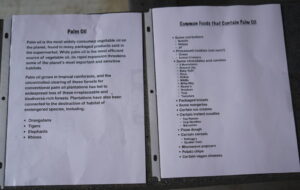
Madeline and Muriel’s palm oil pamphlet, providing education on consumption during their bake sale.
They said there are steps that people can take to make small but meaningful actions, including choosing Rainforest Alliance-approved products, supporting companies participating in 1% for the Planet (which includes Amazon Conservation), and reducing beef consumption. It’s something we have a duty to undertake as Muriel shared that “since a ton of people aren’t doing something about [deforestation of the Amazon], these 10-year-old kids had to go and make cookies.” Their passion is inspirational and demonstrates the duty we have to take action at any level possible to protect the integral ecosystems of our planet.
Conclusions
These stories highlight the diverse and inspiring contributions of women to conservation, ranging from researchers in the field to young activists.
Researchers on the Women in Science panel ended their discussion reflecting on the challenges they faced entering the field while ultimately appreciating the importance of their work contributing to vital research for conservation knowledge. They spoke to younger generations, sharing that with effort and determination, women can make incredible impacts to the fields of science and that girls should know how possible it is to pursue these dreams.
We can perhaps see the newest of the conservation generation in Madeline and Muriel. Once again, they demonstrate that passion and determination can lead to great impacts for conservation. They inspire us to continue our efforts to protect natural beauty and integral biodiversity for the betterment of our world.